
One shuttlecock. Two playing styles. Completely different challenges!
Imagine chasing every shot alone, then switching to a game where your partner suddenly calls, “Mine!” just as you’re about to smash.
That’s the excitement of Badminton Singles vs Doubles. While both formats share the same scoring system, their court boundaries, movement and strategies make them surprisingly different.
Understanding different sports rules and scoring formats makes it easier to follow each game. Explore our guide to sports rules and scoring systems to discover how different sports are played and scored.
Badminton Singles vs Doubles: What’s the Main Difference?
Singles is about individual court coverage and patience, while doubles focuses on teamwork, quick reactions and coordinated attacks.
| Feature | Singles | Doubles |
| Players | 1 per side | 2 per side |
| Court width | 5.18 metres | 6.10 metres |
| Movement | Cover all four corners | Share court coverage |
| Strategy | Placement and patience | Speed and coordination |
| Formation | Central recovery position | Attacking and defensive rotations |
Understanding Badminton Court Dimensions is important because both formats use a 13.40-metre-long court, but their playing widths differ.
How Do Serving Rules Change?
Here’s where beginners often get confused.
Singles: Long and Narrow
In Badminton Singles Rules, the serve must land diagonally within the narrower singles boundaries. The back boundary line is included.
Players frequently use deep serves to push opponents towards the rear court.
Doubles: Short and Wide
Under Badminton Doubles Rules, serves use the wider sidelines, but the rear service boundary is 0.76 metres before the back baseline.
During rallies, however, the full doubles court length becomes available.
Quick tip: An even serving score means serve from the right; an odd score means serve from the left.
Why Are Singles and Doubles Strategies Different?
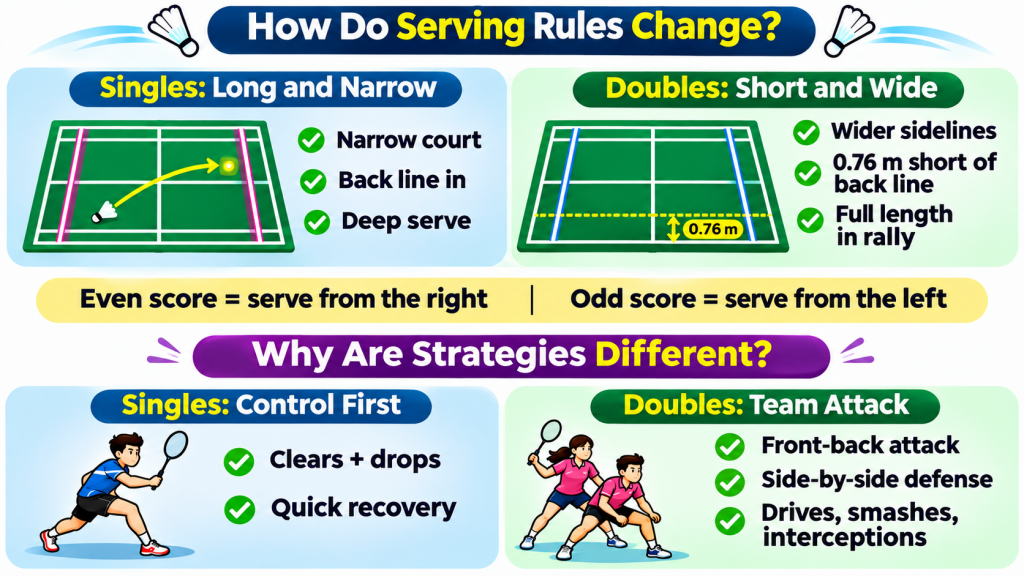
Singles: Control Before Power
A powerful smash is exciting, but smashing every shuttle isn’t always smart.
Successful singles players rely on:
- Deep clears to push opponents backwards.
- Drop shots to draw them towards the net.
- Footwork to recover towards a central position.
The goal is to create openings without leaving your own court exposed.
Doubles: Attack Together, Defend Together
Doubles requires constant awareness of your partner.
Teams generally use front-and-back positioning while attacking and side-by-side positioning while defending.
Quick drives, steep smashes and net interceptions help maintain pressure.
Do Singles and Doubles Have Different Scoring Systems?
No. Both normally follow the same Badminton Scoring Rules.
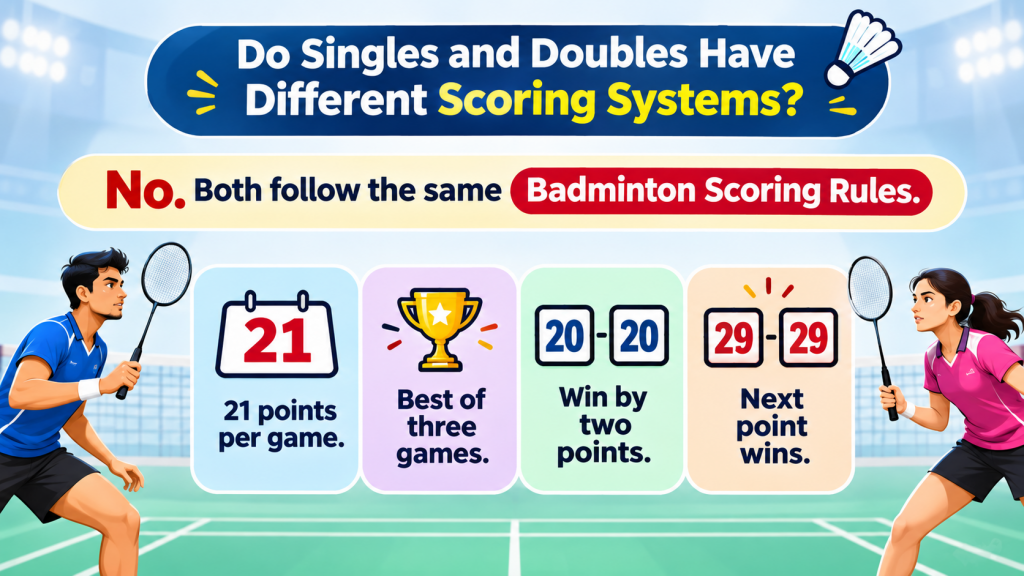
BADMINTON SCORING – QUICK FACT
- 21 points per game.
- Best of three games.
- At 20–20, win by two points.
- At 29–29, the next point wins.
Which Format Should You Play?
Enjoy longer rallies and independent decision-making? Try singles.
Prefer fast exchanges, communication and shared strategy? Try doubles.
Learning both can improve your overall badminton skills.
From Court Action to Tournament Management
Whether it’s singles or doubles, every tournament needs organised fixtures, accurate scores and timely results.
What’s Score helps organisers manage registrations, automatically generate draws, schedule matches and share live scores.
The right platform keeps tournament management organised while players focus on their game.
WHAT’S SCORE – TOURNAMENT IMPACT
300+ Basketball Tournaments Managed on What’s ScoreCreate Your Next Basketball Tournament on What’s Score!Explore tournament management at whatsscore.com.
FAQ
What’s Score helps organisers manage registrations, automatically generate draws, schedule matches, update live scores and publish results—all in one platform.
Yes! Players can view recorded match results, wins, losses, rankings and performance statistics through their digital player profiles.
Yes! Fans can follow live scores, match updates and results. Live streaming is also available for tournaments that enable it.
Ready to Manage Your Next Tournament?
Whether you’re organising singles, doubles or mixed doubles events, What’s Score’s Badminton Tournament Management Software helps you manage player registrations, generate draws, schedule matches and share live scores.
Take your tournament management online with What’s Score. Book a Free Demo to explore the platform, Explore Tournament Groups for tournament setup, and Watch What’s Score TV for live sports coverage and tournament updates.