

One raider. Seven defenders. One chance to escape.
Imagine the excitement of this game on a dusty village ground, long before floodlights, television cameras or digital scoreboards existed.
The History of Kabaddi is a fascinating journey from traditional Indian playgrounds to international championships. What began as a community sport has become a recognised competitive game, attracting players and fans across generations.
Where Did Kabaddi First Begin?
The origin of Kabaddi is rooted in the Indian subcontinent, where regional versions were played for generations.
In Tamil Nadu, a traditional form is known as Sadugudu. Other regions developed their own variations.
Unlike sports requiring expensive equipment, kabaddi needed little more than an open space, two teams and determination.
Players relied on speed, strength, strategy and teamwork to win.
How Did Kabaddi Become an Organised Sport?
As Kabaddi in India grew, common rules became necessary.
The first known framework of modern kabaddi rules was prepared in Maharashtra in 1921 and revised in 1923.
The All India Kabaddi Federation was established in 1950, followed by the Amateur Kabaddi Federation of India in 1972.
These developments helped kabaddi move beyond informal matches into structured competitions.
History of Kabaddi: From Village Grounds to the Asian Games
The Evolution of Kabaddi includes several milestones that changed its future.
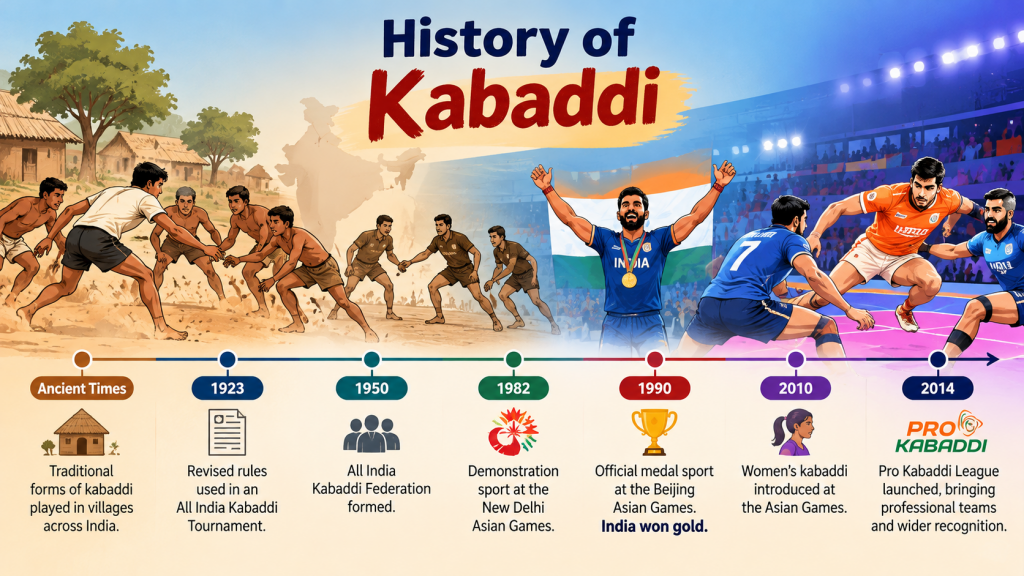
| Year | Important Milestone |
| 1923 | Revised rules used in an All India Kabaddi Tournament |
| 1950 | All India Kabaddi Federation formed |
| 1982 | Demonstration sport at the New Delhi Asian Games |
| 1990 | Official medal sport at the Beijing Asian Games |
| 2010 | Women’s kabaddi introduced at the Asian Games |
| 2014 | Pro Kabaddi League launched |
The turning point in Kabaddi Asian Games History came in 1990, when India won the men’s gold medal in Beijing.
A game once associated with local grounds had reached one of Asia’s biggest sporting stages.
How Did the Pro Kabaddi League Change Everything?
The launch of the Pro Kabaddi League in 2014 brought professional teams, televised matches and wider recognition for talented athletes.
Raiders and defenders became familiar names to fans. Successful raids, tackle points and individual performances became part of everyday sports conversations.
Understanding how points are awarded also makes the game more interesting for fans. Exploring different sports rules and scoring systems helps readers understand how each sport uses its own rules, techniques and scoring methods.
Kabaddi was no longer limited to those watching from the sidelines.
From Village Grounds to Digital Scoreboards
Kabaddi has travelled far, but one thing remains unchanged: every match tells a story.
Today, preserving those stories means keeping accurate tournament records, match results and player performances.
That’s where What’s Score fits into modern sports.
The platform helps tournament organisers manage registrations, automatically generate draws, schedule fixtures and update scores and results. Organisers can also manage their tournaments online, making tournament coordination easier.
Players can maintain digital profiles to follow their recorded sporting achievements, while fans can stay connected through match updates and live sports coverage on What’s Score TV.
Kabaddi’s journey began on village grounds. With better digital records, the achievements of today’s players can become part of tomorrow’s sporting history.
Frequently Asked Questions
Kabaddi has its roots in the Indian subcontinent, where several regional forms developed over time.
Kabaddi appeared as a demonstration sport in 1982 and became an official medal sport in 1990.
The Pro Kabaddi League began in 2014, helping bring professional kabaddi to a wider audience.
Source: History of Kabaddi – Amateur Kabaddi Federation of India